
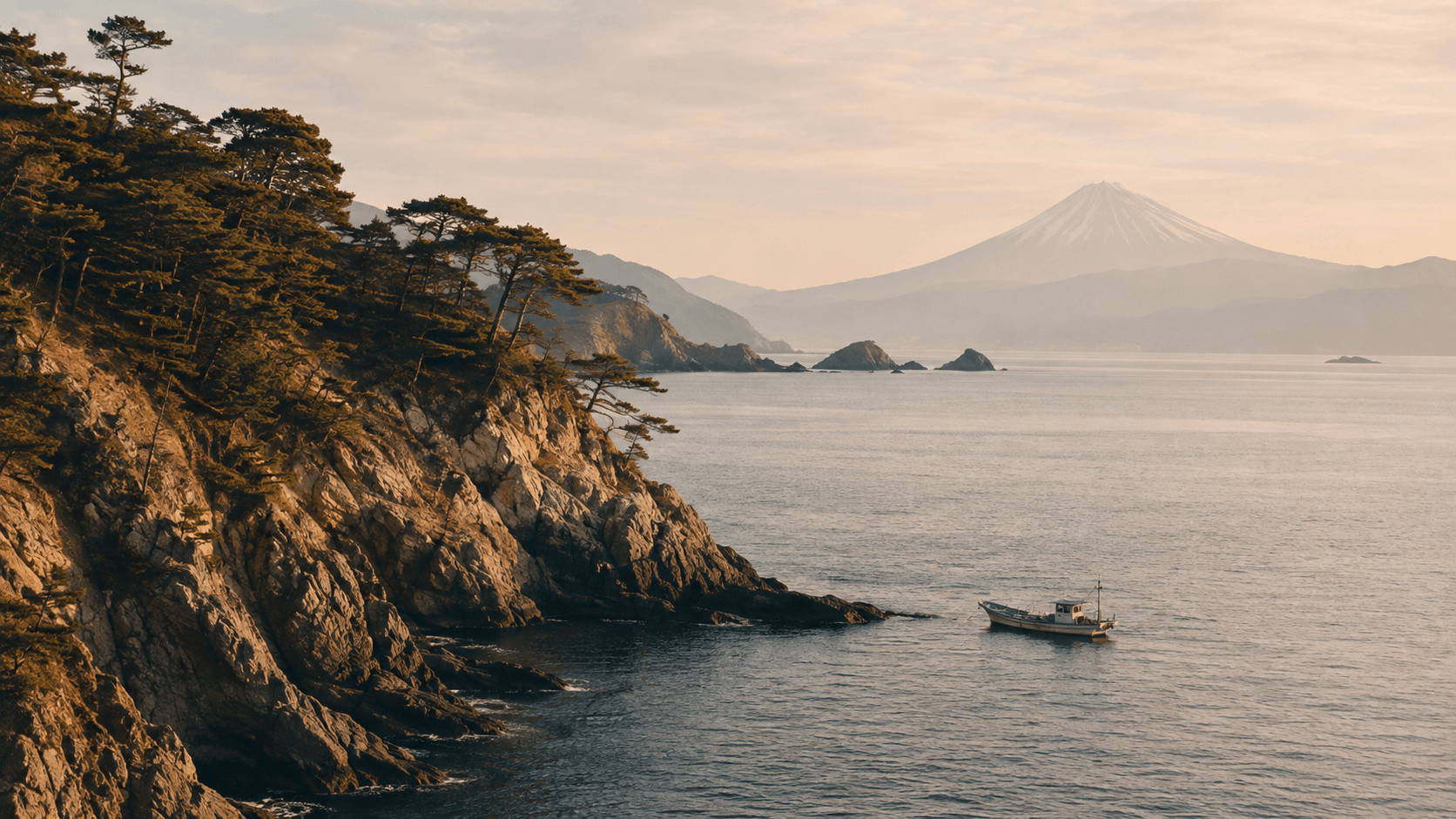
If you’ve searched for “highlights of Nummazaki,” you’ve probably landed on several travel blogs describing a quiet coastal escape in Shizuoka Prefecture — rugged cliffs, glowing tide pools, traditional fishing villages, and Mount Fuji views across Suruga Bay. It sounds like exactly the kind of hidden gem worth planning a trip around.
Here’s the problem: Nummazaki isn’t a real place.
Why “Nummazaki” Doesn’t Exist
A quick check turns up no official tourism listings, no Japanese-language sources, no train station, no municipal record, and no map entry for anywhere called Nummazaki. What does exist is a cluster of nearly identical articles—all published recently, all using the same phrasing, the same invented geography, and the same generic beats (cliffs, tide pools, “untouched” fishing villages) — spread across a network of unrelated-looking travel sites.
That pattern is a signature of AI-generated content farms: a name gets invented, plausible-sounding details get generated around it, and the same piece gets reworded and republished across dozens of domains to capture search traffic on a keyword with no competition. Because nobody else was writing about “Nummazaki” — it doesn’t exist — it was easy for that content to dominate the search results.
If you were planning to actually visit, this matters: any train times, trail directions, or village names attached to “Nummazaki” are fabricated and won’t hold up if you try to use them.
The Real Place Behind the Description
Strip away the invented name, and the description in those articles — a quiet stretch of Suruga Bay coastline in Shizuoka, south of Numazu, near the Izu Peninsula, with cliffs, fishing culture, and Mount Fuji views — matches a real, well-documented area almost exactly: Toi, on the west coast of the Izu Peninsula.
Toi is a small former gold-mining port facing Suruga Bay, and it genuinely delivers everything the “Nummazaki” posts describe:
- Dramatic coastal cliffs and a well-known sunset lookout at Cape Koibito (Lover’s Cape)
- Mount Fuji views across the bay on clear days, especially from the Suruga Bay Ferry crossing from Shimizu Port
- Traditional fishing culture still active at the port, plus fresh Suruga Bay seafood like kinmedai (golden eye snapper) and sakura ebi (cherry blossom shrimp)
- Genuinely low crowds, since most Izu Peninsula tourism concentrates on the east coast (Atami, Ito, Shimoda), leaving the west coast quiet
- Real onsen towns, hiking (Mount Daruma), and nearby sights like the sea caves at Dogashima
In other words: if the idea of “Nummazaki” is what drew you in, Toi and the wider Nishi-Izu coast are the real trip to plan instead — reachable by Shinkansen to Mishima Station plus a short drive, or via the scenic Suruga Bay Ferry from Shimizu.
How to Avoid This in the Future
A few quick checks before trusting a “hidden gem” travel article:
- Search the place name on its own, without “travel guide” or “highlights” attached. If every result is a travel blog and nothing else — no map listing, no local news, no Japanese-language pages for a Japan-based destination — be skeptical.
- Check for it on Google Maps or Japan’s official tourism sites (japan.travel, prefectural tourism boards). Real destinations, even small ones, tend to show up there.
- Watch for repeated phrasing across “different” sites. If five blogs describe a place in nearly identical language, it’s often one source reworded, not five independent visitors.
Looking to Plan an Actual Trip?
If Suruga Bay’s quiet coastline is what you’re after, start with Toi and Nishi-Izu — real fishing ports, real cliffs, and Mount Fuji views that don’t require untangling fact from fabrication first.
